Smith et al: Comparison of bacteria cultured during a total ear canal ablation and subsequent incisional dehiscence in 12 dogs
Veterinary Surgery 3, 2025

🔍 Key Findings

  • Only 1 of 12 dogs (8.3%) cultured the same single organism (Staphylococcus schleiferi) at TECA and dehiscence sites.
  • In 58.3% (7/12), none of the bacteria from TECA cultures were found at dehiscence.
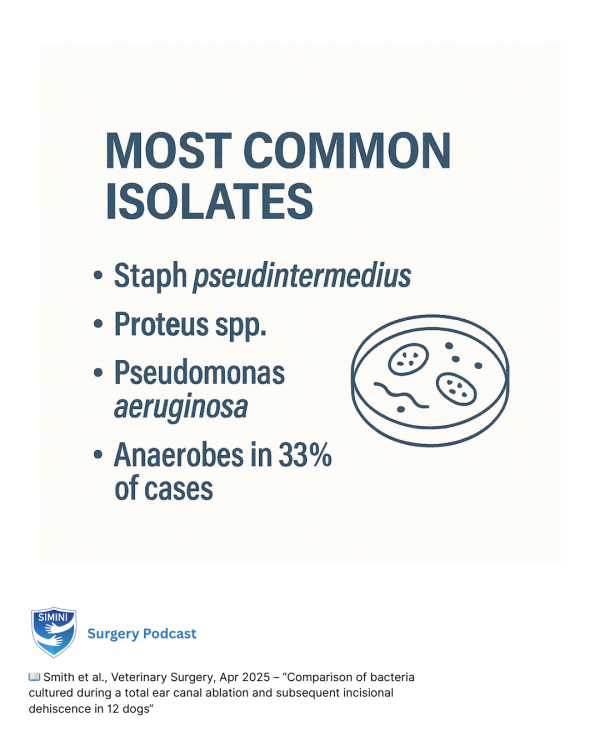
  • Staphylococcus spp. were isolated in 83.3% of dehiscence samples.
  • Methicillin resistance was high among Staphylococcus isolates: 80% at dehiscence.
  • Antibiotic susceptibility differed in 57% (4/7) of cases where the same bacteria were cultured at both time points.
  • TECA cultures were not predictive of bacteria at incisional dehiscence.
  • 75% of dogs healed with either medical or surgical management.

Recommendation: Repeat cultures at dehiscence to guide antibiotic therapy.

Comparison of bacteria cultured during a total ear canal ablation and subsequent incisional dehiscence in 12 dogs

Simini Surgery Review Podcast

How critical is this paper for crushing the Boards?

🚨 Must-know. I’d bet on seeing this.

📚 Useful background, not must-know.

💤 Skip it. Doubt it’ll ever show up.

Thanks for the feedback!
We'll keep fine-tuning the articles vault.
Oops — didn’t go through.
Mind trying that again?

Smith et al: Comparison of bacteria cultured during a total ear canal ablation and subsequent incisional dehiscence in 12 dogs
Veterinary Surgery 3, 2025

🔍 Key Findings

  • Only 1 of 12 dogs (8.3%) cultured the same single organism (Staphylococcus schleiferi) at TECA and dehiscence sites.
  • In 58.3% (7/12), none of the bacteria from TECA cultures were found at dehiscence.
  • Staphylococcus spp. were isolated in 83.3% of dehiscence samples.
  • Methicillin resistance was high among Staphylococcus isolates: 80% at dehiscence.
  • Antibiotic susceptibility differed in 57% (4/7) of cases where the same bacteria were cultured at both time points.
  • TECA cultures were not predictive of bacteria at incisional dehiscence.
  • 75% of dogs healed with either medical or surgical management.

Recommendation: Repeat cultures at dehiscence to guide antibiotic therapy.

Simini Surgery Review Podcast

Know What Matters in the Literature - and Why

We distill peer-reviewed surgical studies into clinically relevant summaries and
exam-style questions, so you can make informed decisions with confidence.

Free Access. No Spam. Just Smarter Surgical Learning

Multiple Choice Questions on this study

In Smith 2025 et al., on bacterial cultures in TECA dehiscence, what percentage of dogs had changes in antibiotic susceptibility when the same bacteria were isolated at both TECA and dehiscence?

A. 20%
B. 29%
C. 43%
D. 57%
E. 71%

Answer: 57%

Explanation: In 4 of 7 cases where the same bacteria were cultured, antibiotic susceptibility differed.
In Smith 2025 et al., on bacterial cultures in TECA dehiscence, what percentage of dogs had the same single bacterial species cultured at both time points?

A. 0%
B. 8.3%
C. 16.7%
D. 25%
E. 33.3%

Answer: 8.3%

Explanation: Only 1 out of 12 dogs (8.3%) had the same single bacteria (Staph schleiferi) at both TECA and dehiscence.
In Smith 2025 et al., on bacterial cultures in TECA dehiscence, what percentage of dogs had Staphylococcus spp. isolated at the time of incisional dehiscence?

A. 41.7%
B. 50.0%
C. 66.7%
D. 75.0%
E. 83.3%

Answer: 83.3%

Explanation: Staphylococcus spp. were found in 10 of 12 dehiscence cultures (83.3%).
In Smith 2025 et al., on bacterial cultures in TECA dehiscence, what was observed about methicillin resistance among Staphylococcus spp. cultured at incisional dehiscence?

A. None were resistant
B. 20% were resistant
C. 40% were resistant
D. 60% were resistant
E. 80% were resistant

Answer: 80% were resistant

Explanation: Of the Staphylococcus spp. found at dehiscence, 80% were methicillin resistant.
In Smith 2025 et al., on bacterial cultures in TECA dehiscence what was the conclusion about using intraoperative cultures to guide treatment of dehiscence?

A. They were highly predictive of future bacteria
B. They should be avoided altogether
C. They were moderately predictive
D. They were not predictive and new cultures should be performed
E. New cultures should only be performed in recurrent cases

Answer: They were not predictive and new cultures should be performed

Explanation: Cultures during TECA were not reliable predictors of pathogens at dehiscence and repeat cultures were recommended.

Access the full library of surgical summaries and exam-style questions.

Educational content developed independently and supported by Simini.

The maker of Simini Protect Lavage.