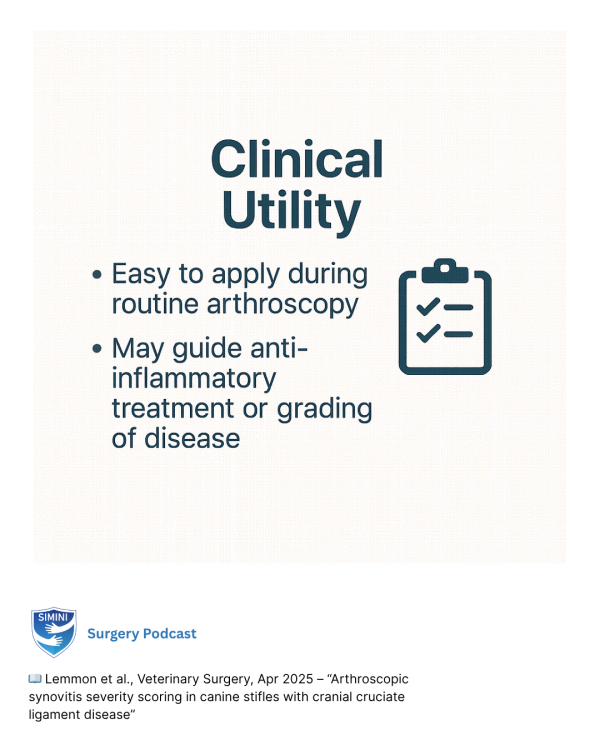
Lemmon et al: Arthroscopic synovitis severity scoring in canine stifles with cranial cruciate ligament disease
Veterinary Surgery 3, 2025

🔍 Key Findings

Synovitis was present in 100% of canine stifles with CCL disease (n = 163).

The most frequent severity score was 3/5 (55.2%), followed by 4/5 (24.5%).

Higher synovitis scores were significantly associated with:

  • Higher median cartilage scores (p = .042, OR = 2.1 per unit increase)
  • Longer duration of clinical signs (p < .001, OR = 1.27 per month)

Bodyweight (p = .083) and sex (p = .17) were not statistically significant in multivariable analysis.

Bucket handle meniscal tears were not associated with synovitis severity.

Clinical implication: Earlier intervention may help reduce synovitis and slow OA progression.

Arthroscopic synovitis severity scoring in canine stifles with cranial cruciate ligament disease

Simini Surgery Review Podcast

How critical is this paper for crushing the Boards?

🚨 Must-know. I’d bet on seeing this.

📚 Useful background, not must-know.

💤 Skip it. Doubt it’ll ever show up.

Thanks for the feedback!
We'll keep fine-tuning the articles vault.
Oops — didn’t go through.
Mind trying that again?

Lemmon et al: Arthroscopic synovitis severity scoring in canine stifles with cranial cruciate ligament disease
Veterinary Surgery 3, 2025

🔍 Key Findings

Synovitis was present in 100% of canine stifles with CCL disease (n = 163).

The most frequent severity score was 3/5 (55.2%), followed by 4/5 (24.5%).

Higher synovitis scores were significantly associated with:

  • Higher median cartilage scores (p = .042, OR = 2.1 per unit increase)
  • Longer duration of clinical signs (p < .001, OR = 1.27 per month)

Bodyweight (p = .083) and sex (p = .17) were not statistically significant in multivariable analysis.

Bucket handle meniscal tears were not associated with synovitis severity.

Clinical implication: Earlier intervention may help reduce synovitis and slow OA progression.
Simini Surgery Review Podcast

Know What Matters in the Literature - and Why

We distill peer-reviewed surgical studies into clinically relevant summaries and
exam-style questions, so you can make informed decisions with confidence.

Free Access. No Spam. Just Smarter Surgical Learning

Multiple Choice Questions on this study

In Lemmon 2025 et al., on synovitis severity scoring, what variable was most strongly associated with increased cartilage damage?

A. Bodyweight
B. Sex
C. Duration of clinical signs
D. Bucket handle meniscal tear
E. Synovitis severity score

Answer: Synovitis severity score

Explanation: Higher synovitis scores were significantly associated with worse cartilage grades (OR = 2.1, p = .042).
In Lemmon 2025 et al., on synovitis severity scoring, what was concluded about the impact of bucket handle meniscal tears on synovitis severity?

A. They increased synovitis score
B. They were protective
C. They were significantly correlated with sex
D. They had no significant effect
E. They were associated with milder scores

Answer: They had no significant effect

Explanation: Meniscal tears were not significantly associated with synovitis grade.
In Lemmon 2025 et al., on synovitis severity scoring, what clinical implication was proposed based on the findings?

A. Delaying surgery until Grade 4 synovitis
B. Only treating male dogs surgically
C. Synovitis is unrelated to cartilage damage
D. Earlier intervention may help reduce synovitis
E. Early intervention worsens cartilage outcomes

Answer: Earlier intervention may help reduce synovitis

Explanation: Higher synovitis scores were tied to worse cartilage lesions, supporting early treatment.
In Lemmon 2025 et al., on synovitis severity scoring, what was the most common synovitis severity score observed during arthroscopy?

A. 1/5
B. 2/5
C. 3/5
D. 4/5
E. 5/5

Answer: 3/5

Explanation: Score 3/5 was the most frequently observed severity grade, present in 55.2% of joints.
In Lemmon 2025 et al., on synovitis severity scoring, what was the association between symptom duration and synovitis severity?

A. No association found
B. Significant positive correlation
C. Negative correlation
D. Non-linear relationship
E. Dependent on breed

Answer: Significant positive correlation

Explanation: Longer clinical signs were associated with higher synovitis scores (OR = 1.27 per month, p < .001).

Access the full library of surgical summaries and exam-style questions.

Educational content developed independently and supported by Simini.

The maker of Simini Protect Lavage.