Inal et al: Survival Rate of High-Rise Syndrome Cases Using Animal Trauma Triage Score in Cats
Veterinary and Comparative Orthopedics and Traumatology 1, 2025

🔍 Key Findings

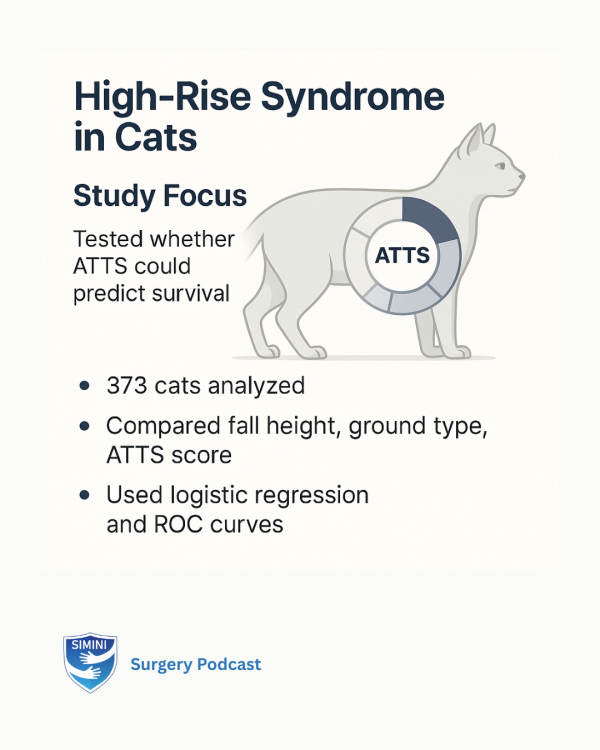
Sample: 373 cats with high-rise syndrome (HRS) from 2017–2020.
ATTS was the only significant predictor of survival (p < 0.001); each point increase decreased survival odds (OR = 0.46).
AUC for ATTS ROC curve: 0.857 (95% CI: 0.788–0.926).
Floor height, lesion type, and ground surface were not significantly associated with survival.
Odds of injury were 7.98× higher when landing on hard vs. soft surface (p < 0.001).
16.96× increased injury risk from the fourth vs. third floor (p = 0.008).
Cats with ATTS ≥7 had 62% mortality; median ATTS increased with floor height (r = 0.244, p < 0.001).
Thoracic and vertebral trauma were most common causes of death.
Only 32% of cats had the “classic” HRS triad (pneumothorax, epistaxis, hard palate fracture).
Survival Rate of High-Rise Syndrome Cases Using Animal Trauma Triage Score in Cats

Simini Surgery Review Podcast

How critical is this paper for crushing the Boards?

🚨 Must-know. I’d bet on seeing this.

📚 Useful background, not must-know.

💤 Skip it. Doubt it’ll ever show up.

Thanks for the feedback!
We'll keep fine-tuning the articles vault.
Oops — didn’t go through.
Mind trying that again?

Inal et al: Survival Rate of High-Rise Syndrome Cases Using Animal Trauma Triage Score in Cats
Veterinary and Comparative Orthopedics and Traumatology 1, 2025

🔍 Key Findings

Sample: 373 cats with high-rise syndrome (HRS) from 2017–2020.
ATTS was the only significant predictor of survival (p < 0.001); each point increase decreased survival odds (OR = 0.46).
AUC for ATTS ROC curve: 0.857 (95% CI: 0.788–0.926).
Floor height, lesion type, and ground surface were not significantly associated with survival.
Odds of injury were 7.98× higher when landing on hard vs. soft surface (p < 0.001).
16.96× increased injury risk from the fourth vs. third floor (p = 0.008).
Cats with ATTS ≥7 had 62% mortality; median ATTS increased with floor height (r = 0.244, p < 0.001).
Thoracic and vertebral trauma were most common causes of death.
Only 32% of cats had the “classic” HRS triad (pneumothorax, epistaxis, hard palate fracture).

Simini Surgery Review Podcast

Know What Matters in the Literature - and Why

We distill peer-reviewed surgical studies into clinically relevant summaries and
exam-style questions, so you can make informed decisions with confidence.

Free Access. No Spam. Just Smarter Surgical Learning

Multiple Choice Questions on this study

In İnal 2025 et al., on feline high-rise trauma, what percentage of cats lacked the classic triad of HRS signs (epistaxis, pneumothorax, hard palate fracture)?

A. 12%
B. 28%
C. 44%
D. 68%
E. 79%

Answer: 68%

Explanation: 68.1% of cats lacked the classic triad of pneumothorax, epistaxis, and hard palate fracture
In İnal 2025 et al., on feline high-rise trauma, what was the survival rate across all included cats?

A. 88.3%
B. 91.5%
C. 94.9%
D. 97.1%
E. 100%

Answer: 94.9%

Explanation: 354 out of 373 cats survived, giving a 94.9% survival rate
In İnal 2025 et al., on feline high-rise trauma, what was the area under the ROC curve (AUC) for ATTS in predicting mortality?

A. 0.62
B. 0.74
C. 0.81
D. 0.86
E. 0.91

Answer: 0.86

Explanation: The AUC was 0.857, indicating good predictive performance for ATTS
In İnal 2025 et al., on feline high-rise trauma, which surface type was associated with significantly higher odds of injury?

A. Soft surface
B. Tile surface
C. Grass
D. Concrete
E. Carpet

Answer: Concrete

Explanation: Cats falling on hard (concrete) surfaces had 7.98× greater odds of injury than those landing on soft surfaces
In İnal 2025 et al., on feline high-rise trauma, which factor was most predictive of nonsurvival?

A. Height of fall
B. Type of injuries
C. Ground surface
D. Animal Trauma Triage Score (ATTS)
E. Body weight

Answer: Animal Trauma Triage Score (ATTS)

Explanation: ATTS was the only variable significantly associated with survival; each 1-point increase increased nonsurvival odds by 0.46×

Access the full library of surgical summaries and exam-style questions.

Educational content developed independently and supported by Simini.

The maker of Simini Protect Lavage.