Wilson et al: Evaluation of three acetabular measurement methods for total hip replacement in dogs
Veterinary Surgery 1, 2025

🔍 Key Findings

Study population: 73 hips from 60 dogs undergoing cementless THR.
Methods evaluated:

  • ACVD/ACOLL (acetabular circle on VD or OLL view)
  • ALVD/ALOLL (acetabular line)
  • FHCVD/FHCOLL/FHCCCHB (femoral head circle)
Findings:
  • Intraobserver repeatability and interobserver consistency were excellent for ACVD and ACOLL.
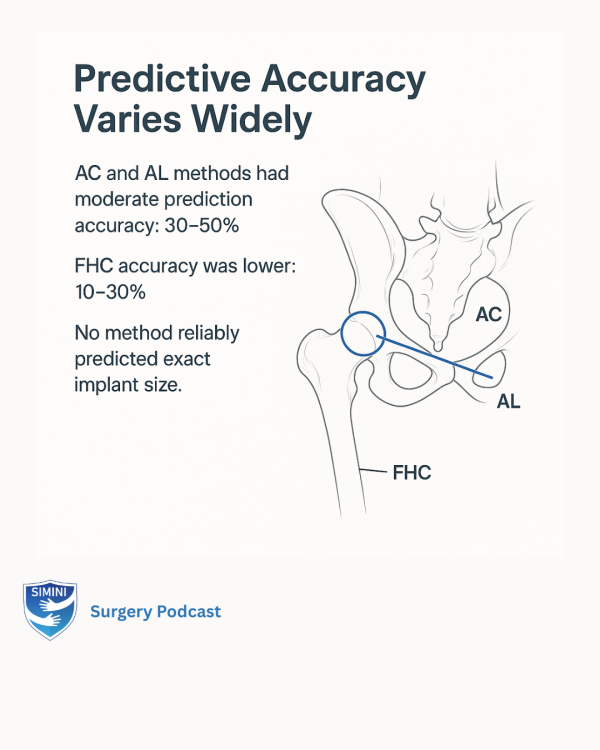
  • FHC methods consistently underestimated actual cup size by 2.4–3.6 mm.
  • AC and AL methods had low bias (±0.5 mm) and better predictive value.
  • OA severity negatively affected the accuracy of all measurements (p < .05).
  • Highest predictive accuracy was ~49% using ACVD with rounding down protocol.

Evaluation of three acetabular measurement methods for total hip replacement in dogs

Simini Surgery Review Podcast

How critical is this paper for crushing the Boards?

🚨 Must-know. I’d bet on seeing this.

📚 Useful background, not must-know.

💤 Skip it. Doubt it’ll ever show up.

Thanks for the feedback!
We'll keep fine-tuning the articles vault.
Oops — didn’t go through.
Mind trying that again?

Wilson et al: Evaluation of three acetabular measurement methods for total hip replacement in dogs
Veterinary Surgery 1, 2025

🔍 Key Findings

Study population: 73 hips from 60 dogs undergoing cementless THR.
Methods evaluated:

  • ACVD/ACOLL (acetabular circle on VD or OLL view)
  • ALVD/ALOLL (acetabular line)
  • FHCVD/FHCOLL/FHCCCHB (femoral head circle)
Findings:
  • Intraobserver repeatability and interobserver consistency were excellent for ACVD and ACOLL.
  • FHC methods consistently underestimated actual cup size by 2.4–3.6 mm.
  • AC and AL methods had low bias (±0.5 mm) and better predictive value.
  • OA severity negatively affected the accuracy of all measurements (p < .05).
  • Highest predictive accuracy was ~49% using ACVD with rounding down protocol.
Simini Surgery Review Podcast

Know What Matters in the Literature - and Why

We distill peer-reviewed surgical studies into clinically relevant summaries and
exam-style questions, so you can make informed decisions with confidence.

Free Access. No Spam. Just Smarter Surgical Learning

Multiple Choice Questions on this study

In Wilson 2025 et al., on acetabular measurement accuracy, what was the main drawback of femoral head circle methods?

A. Overestimated cup size
B. Low repeatability
C. Low correlation with OA severity
D. Underestimated cup size
E. Not feasible in most views

Answer: Underestimated cup size

Explanation: FHC-based methods underestimated cup size by 2.4–3.6 mm.
In Wilson 2025 et al., on acetabular measurement accuracy, which method demonstrated the highest intra- and interobserver reliability?

A. FHCVD
B. FHCCCHB
C. ACVD
D. ALVD
E. FHCOLL

Answer: ACVD

Explanation: The acetabular circle method on VD view (ACVD) showed the highest intra- and interobserver agreement.
In Wilson 2025 et al., on acetabular measurement accuracy, what was the maximum prediction accuracy using ACVD with rounding down?

A. 23%
B. 33%
C. 49%
D. 60%
E. 74%

Answer: 49%

Explanation: Using ACVD and rounding down gave the best cup size match in 49% of cases.
In Wilson 2025 et al., on acetabular measurement accuracy, what factor significantly reduced measurement accuracy across all methods?

A. Patient age
B. Body weight
C. Radiographic magnification
D. Osteoarthritis severity
E. Femoral version

Answer: Osteoarthritis severity

Explanation: Higher OA severity was associated with greater prediction error (p < .05).
In Wilson 2025 et al., on acetabular measurement accuracy, which pair of measurement methods showed the least bias in predicting final cup size?

A. ACVD and ALVD
B. FHCCCHB and FHCOLL
C. FHCVD and FHCCCHB
D. ACOLL and ALVD
E. FHCVD and ALVD

Answer: ACVD and ALVD

Explanation: These methods had a mean prediction bias within ±0.5 mm of final cup size.

Access the full library of surgical summaries and exam-style questions.

Educational content developed independently and supported by Simini.

The maker of Simini Protect Lavage.